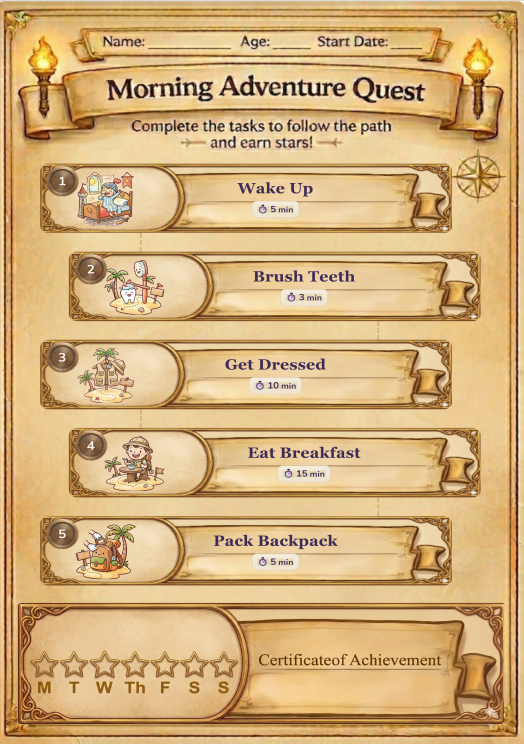
Why families use a daily routine chart for kids
A daily routine chart for kids creates structure across the whole day, not just one transition point. That is powerful for families who feel like they are always managing the next urgent step. A clear visual routine reduces morning chaos, supports calmer afterschool flow, and prevents bedtime drift. Children benefit because expectations stay visible and predictable. Parents benefit because they can point to the chart instead of repeating instructions over and over.
Start with the routine moments that create the most stress in your home. For many families, those are wake-up, school prep, homework, chores, and bedtime. Keep tasks short and specific: put on shoes is better than get ready. If your child is younger, reduce the number of steps and use more icons. If your child is older, add text details and optional time blocks. The goal is clarity and consistency, not a perfect schedule every single day.
How to make this daily routine chart for kids work at home
Daily charts also teach self-management skills that carry into school and life. When children practice checking the next step, completing it, and moving on, they build planning habits over time. You can reinforce this with simple checkmarks, stickers, or verbal encouragement tied to effort. Avoid overcomplicating rewards. The strongest long-term result comes from making routine success feel normal and repeatable rather than rare or heavily negotiated.
Use the preloaded daily routine template here to launch quickly. Edit task names to fit your family, print the chart, and place it where your child starts and ends the day. Review it together once in the morning and once in the evening to build the habit loop. Most families notice less friction within days and stronger independence within a couple of weeks when the same sequence is used consistently.
What to include in your kids daily routine chart
Most families get the best results when the printable mirrors the real transition points that happen every day. For this daily routine chart for kids, that usually means keeping the routine anchored around wake up, morning hygiene, breakfast, school prep, and one final completion step your child can recognize without extra explanation. When the sequence is visible and realistic, children spend less time asking what comes next and more time moving through the routine with confidence.
This DaylyKid template already includes 7 editable steps, so you can shorten, rename, or reorder tasks without starting over. That makes it easier to build a reusable printable for school days, weekends, therapy days, or travel days while keeping the same visual language. Searchers looking for a daily routine chart for kids or kids daily routine chart usually want something practical they can print and use immediately, so the strongest version is the one your family can repeat consistently.
- Wake Up (5 min)
- Morning Hygiene (8 min)
- Breakfast (15 min)
- School Prep (10 min)
- Homework Time (20 min)
Tips for better follow-through with daily routine chart for kids
Review the chart before the routine begins, not only after resistance starts. Point to one next step, use short praise after completion, and keep your prompts consistent from day to day. Children are more likely to follow a visual plan when it feels like a shared roadmap instead of another correction delivered in the moment.
You can also improve follow-through by pairing the printable with simple environmental supports. Put the chart at eye level, lay out materials ahead of time, and use one predictable transition phrase so the routine feels familiar. Those small adjustments are especially helpful around wake up and morning hygiene, because those moments tend to create the most friction when a child is rushed, distracted, or tired.